
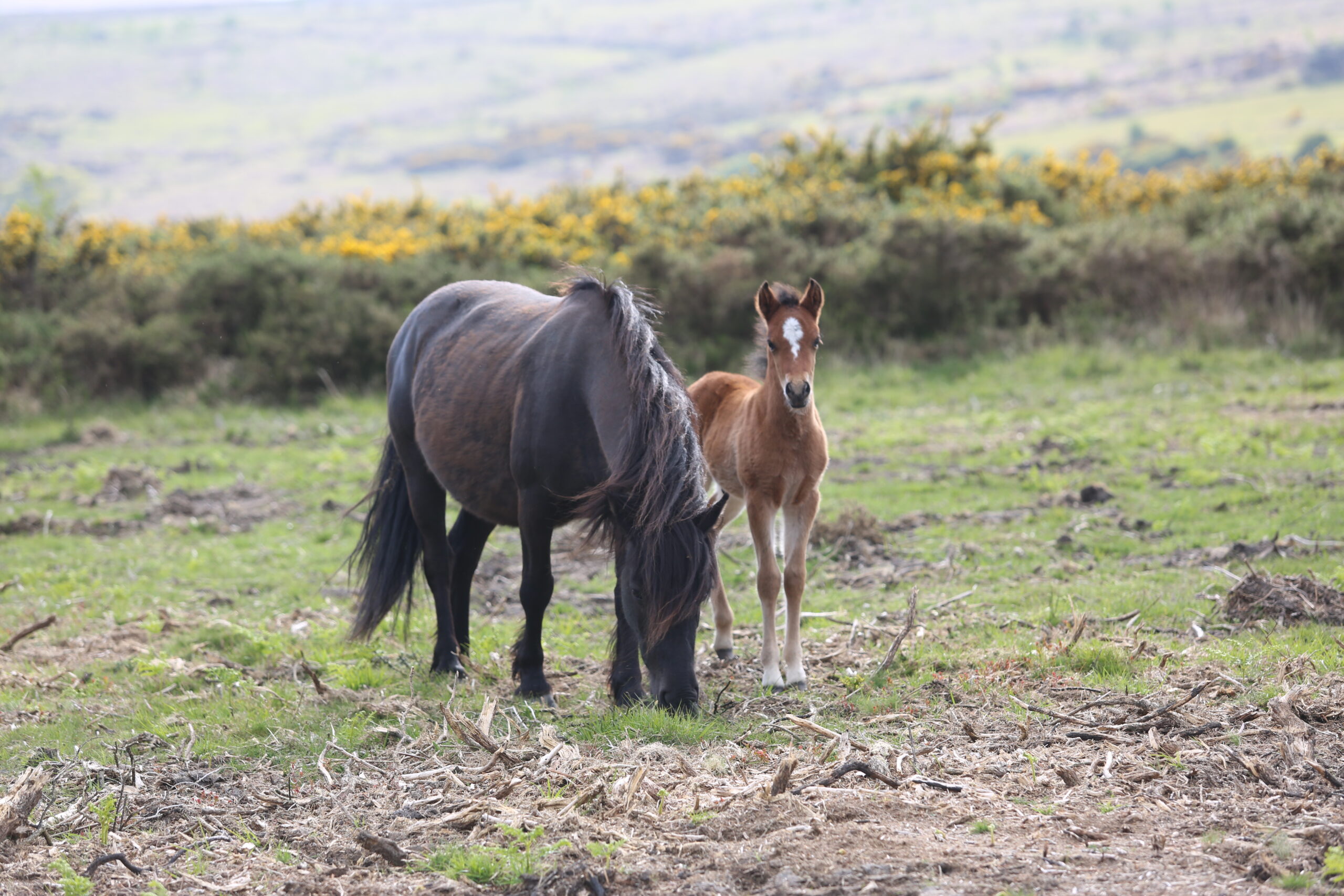
The value of conservation grazing by heritage Dartmoor ponies
Written by Ellie Pooley
Conservation grazing is the strategic use of domestic livestock to achieve defined conservation objectives. By grazing and browsing vegetation, livestock influence plant communities, habitat structure and ecological processes, creating the varied conditions that support a rich diversity of plants, invertebrates, birds, reptiles and mammals.
Grazing animals have shaped the landscapes of Dartmoor for centuries. Many of the habitats we value today, including heathland, acid grassland and moorland mosaics, have developed alongside traditional grazing practices. Without appropriate grazing, these habitats can become dominated by competitive species such as purple moor grass (Molinia caerulea), bracken (Pteridium aquilinum) and scrub. As these species spread, they reduce structural diversity, suppress other plants and diminish the range of wildlife the habitat can support.
Carefully managed conservation grazing helps maintain open habitats, restore natural ecological processes and create the varied vegetation structure upon which many species depend.
Why ponies are different
Heritage Dartmoor ponies are exceptionally well suited to conservation grazing. Hardy, resilient and adapted to the challenging conditions of the moor, they are able to thrive year-round on a wide range of vegetation.
Unlike many other grazing animals, equids possess highly mobile, prehensile lips that allow them to graze with remarkable precision. This enables ponies to selectively feed on coarse grasses while browsing young scrub and less palatable plants. They are also able to access steep slopes, wet ground and other areas that may be less suitable for larger livestock.
As they move naturally through the landscape, ponies create a mosaic of shorter and taller vegetation. Their hooves disturb small patches of ground, creating opportunities for seed germination and the establishment of new plants. Together, these natural grazing and trampling processes increase habitat diversity and contribute to healthier, more resilient ecosystems.
The Bellever research
The Dartmoor Pony Heritage Trust has been able to demonstrate these benefits through peer-reviewed research undertaken with the University of Plymouth at the Trust’s Bellever conservation site.
Between 2017 and 2019, researchers investigated whether heritage Dartmoor ponies could be encouraged to graze areas dominated by purple moor grass (Molinia caerulea), a species that can suppress heather regeneration and reduce the ecological value of heathland. Rather than introducing fencing or intensive management, researchers used strategically placed salt blocks to encourage the ponies to spend more time grazing selected areas.
The results were significant.
Where pony grazing increased:
- the cover of purple moor grass was reduced;
- more areas of bare ground were created, providing ideal conditions for seed germination;
- mature heather plants were found to be in significantly better condition; and
- grazed areas recorded an eighteen-fold increase in heather seedlings compared with ungrazed control plots.
The study also demonstrated that salt blocks could be used successfully to attract ponies to specific areas of heathland without the need for fencing, providing land managers with a practical and low-impact conservation tool.
These findings show that heritage Dartmoor ponies are not simply maintaining existing habitats. Through their natural grazing and trampling behaviour they can actively help restore degraded heathland by reducing the dominance of purple moor grass and creating the conditions needed for heather and other heathland species to regenerate.
Benefits beyond biodiversity
The value of conservation grazing extends beyond plants and wildlife. Appropriate grazing helps maintain the open character of Dartmoor’s historic landscapes, prevents archaeological features from becoming obscured by scrub encroachment and preserves the distinctive appearance of the moor.
Conservation grazing also provides an important practical role for heritage Dartmoor ponies within modern landscape management. By demonstrating how a rare native breed can deliver measurable conservation outcomes, it helps secure a sustainable future for both the ponies and the landscapes they have shaped for generations.
Looking ahead
At the Dartmoor Pony Heritage Trust, conservation grazing lies at the heart of our work. By supporting pony keepers, collaborating with conservation organisations and continuing to build the scientific evidence base, we are demonstrating that heritage Dartmoor ponies are an important part of nature recovery on Dartmoor.
As pressures on the natural environment continue to grow, understanding how native grazing animals can help restore resilient ecosystems has never been more important. The research at Bellever provides clear evidence that heritage Dartmoor ponies are not simply part of Dartmoor’s history—they are helping to shape its future.
Further reading
Lunt, P.H., Leigh, J.L., McNeil, S.A. & Gibb, M.J. (2021). Using Dartmoor ponies in conservation grazing to reduce Molinia caerulea dominance and encourage germination of Calluna vulgaris in heathland vegetation on Dartmoor, UK. Conservation Evidence Journal, 18, 25–30. https://doi.org/10.52201/CEJ18SVSR7750
Ellie Pooley
Ellie Pooley holds a BSc (Hons) in Geography and is currently studying for an MSc in Sustainable Environmental Management at the University of Plymouth. As Conservation Officer at the Dartmoor Pony Heritage Trust, she is developing the Trust’s conservation grazing programme, working with pony keepers, land managers and conservation partners to demonstrate the role that heritage Dartmoor ponies can play in nature recovery while helping to secure the future of the breed.
Alongside her work with the Trust, Ellie completed a placement with Natural England, gaining practical experience across a number of National Nature Reserves. Her interests focus on conservation grazing, habitat restoration and sustainable land management, with particular emphasis on the role of native livestock in delivering biodiversity gains.