
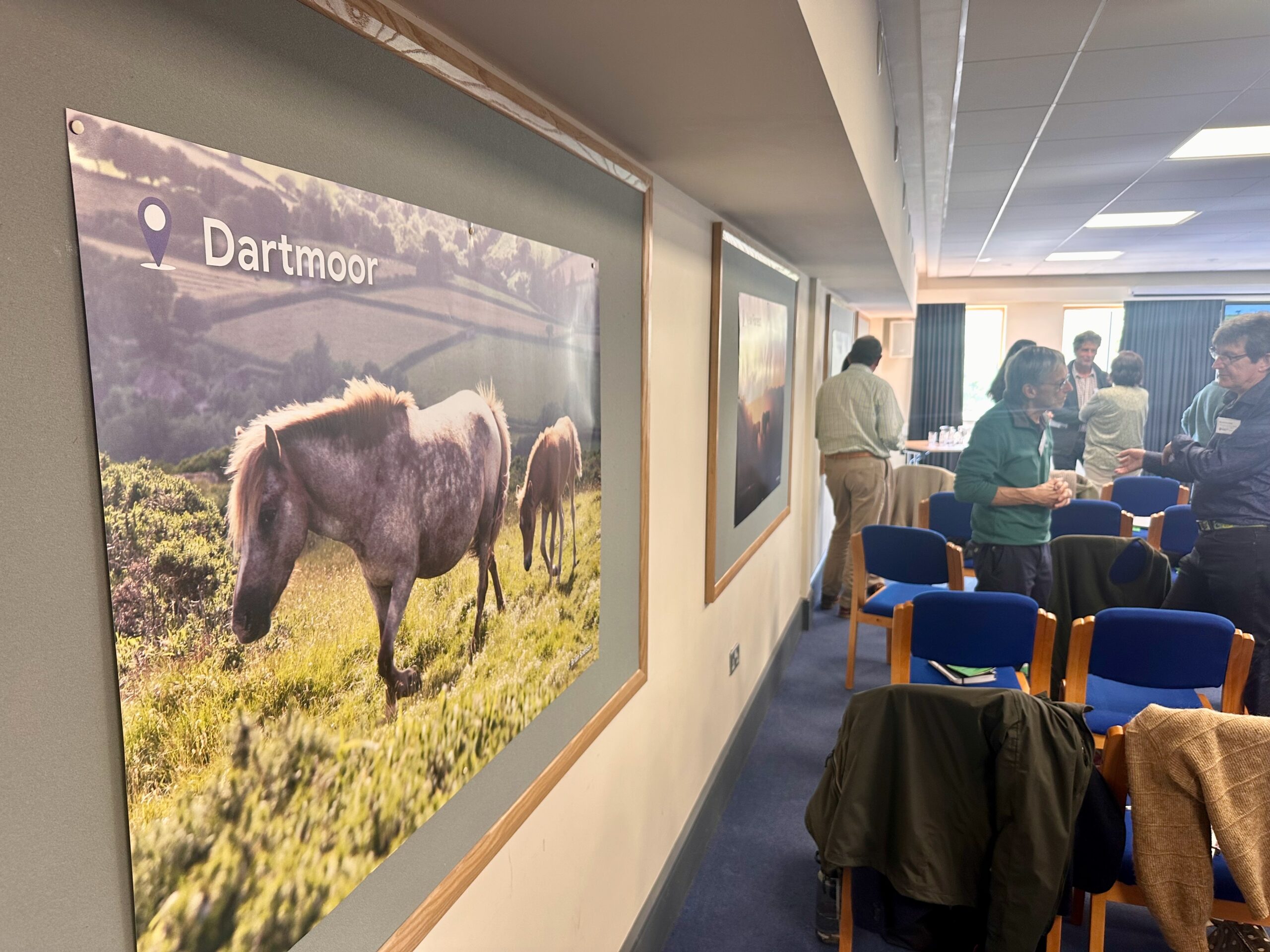
Finding common ground for the future of ponies on our commons
On 8 September, representatives of the Dartmoor Pony Heritage Trust attended World Horse Welfare’s Equine Common Ground Conference. The event brought together people working with equines across some of the UK’s common grazing landscapes.
Held at Glenda Spooner Farm, the conference included experience from Dartmoor, Bodmin Moor, Exmoor, the New Forest and Gelligaer and Merthyr. Each has its own history and challenges. However, as the discussions unfolded, it became clear just how many of those challenges are shared.
Common challenges across the commons
Ponies and other equines have been part of these landscapes for centuries. They are part of their history and culture. Through grazing, they can also play an important role in managing habitats and supporting biodiversity.
However, that heritage alone does not protect their welfare or guarantee their future.
Much of the discussion came back to some practical questions. Who owns a pony and who is responsible for it? How is it identified? Who decides whether it breeds? What happens when there is a welfare problem? Most importantly, how can problems be prevented before they reach crisis point?
There were very different experiences to draw on.
Richard Deakin, New Forest elected Verderer and chair of the Stallion Committee, and Jonathan Gerrelli, New Forest head agister, explained how the New Forest’s long-established system of governance works in practice. Their discussion covered identification, breeding, welfare, drifts and enforcement.
Experiences from Bodmin Moor, Exmoor and Gelligaer and Merthyr were different again. Yet the same issues kept surfacing. Ownership, identification, responsible breeding, enforcement and funding were all common concerns. So too was the need for people and organisations to work together.
Giving ponies a value
Value was another important part of the conversation.
Ponies have value as grazers and can have an important ecological role. They also have a cultural value for the communities around them. However, they need a financial value too.
Finding sustainable roles and markets for ponies is part of supporting their long-term welfare. It also gives breeders and keepers a reason to continue doing what they do.
For the Dartmoor Pony Heritage Trust, much of this resonated strongly with our own work. Our aim is to secure a thriving future for heritage Dartmoor ponies by supporting breeders and keepers and championing their value to Dartmoor’s landscape, culture and future.
Hearing how other commons are tackling similar issues was extremely useful. It also gave us an opportunity to share some of the experience from Dartmoor.
Looking upstream
Malcolm Morley, director of UK at World Horse Welfare, brought the conference to a close. He reflected on what he had heard throughout the day.
“What I’ve heard is a bunch of people trying to collaborate and solve problems,” he said. “Nobody here has been saying, ‘I know all the solutions,’ and it’s felt a really collaborative environment.”
Despite the different histories and circumstances of the commons represented, he too had been struck by how much common ground there was.
“These equines have all been part of these landscapes for centuries. They’re part of their history, their culture, their ecology. And it’s pretty clear to me that that heritage is not protecting their welfare.”
Why ownership matters
If Malcolm had to take one message from the day, he said it would be ownership.
“Without clear ownership, everything else seems to fall apart. Who’s responsible for the pony? Who decides whether they breed? Who calls the vet? Who pays? Who can move it, sell it, euthanise it? And who is accountable when their welfare is poor?
“When ownership is unclear, the responsibility becomes unclear, and welfare falls straight into that gap.”
Identification goes hand in hand with ownership. Knowing which animals are there and who they belong to, Malcolm said, is “not bureaucracy. It’s what makes that responsibility of ownership possible.”
There was also an interesting discussion around visible identification and branding. Branding itself causes a welfare harm. However, Malcolm posed the question of whether the wider welfare benefits of clear, visible identification could outweigh that harm.
Governance and enforcement
Governance also matters because commons are complicated places.
Commoners, landowners, local authorities, police, government, vets, communities and the public can all be involved. Sometimes they operate across different administrative boundaries. They may not always share the same view about what is best for the animals.
The New Forest showed what can be achieved when established structures bring those different interests together. Malcolm also highlighted the importance of enforcement and the ability to act when necessary.
“Good governance and enforcement isn’t something that sits around welfare,” he said. “It’s a really key part of it.”
Funding, particularly concerns about its future, was another part of the conversation.
Sustainable funding is not simply about finding money to deal with the welfare crisis in front of you. Instead, it is about creating a system that helps prevent those crises in the first place.
Breeding decisions shape future welfare
Breeding is another area where looking ahead matters.
“Breeding is a welfare decision that’s made years in advance,” Malcolm said.
Decisions made about breeding now can have consequences much further down the line. Therefore, preventing overpopulation and unwanted animals is part of preventing future welfare problems.
Malcolm also spoke about a subject which can provoke strong feelings: horses entering the food chain.
He made World Horse Welfare’s position clear. The charity is not opposed to horses entering the food chain, provided their welfare is paramount throughout their lives, during transport and at slaughter.
That approach goes back to the charity’s beginnings. Ada Cole founded the movement that became World Horse Welfare almost a century ago. Her objection was not to horses being used for meat, but to the appalling conditions they endured on their journey to slaughter.
“Welfare is about the quality of the animal’s life and death,” Malcolm said. “It’s not imposing our sentiment on what its life must be used for.”
Preventing the next welfare crisis
As he drew the day together, Malcolm’s list was straightforward: clear ownership, good governance, identification, responsible breeding and population management, sustainable funding and people prepared to work towards a shared goal.
Almost exactly a century ago, Ada Cole saw suffering and decided that simply accepting it was not enough. Her reported final words were: “The work must go on.”
Malcolm had opened the conference with a quote from Desmond Tutu. He returned to it at the end:
“There comes a point where we need to stop just pulling people out of the river; we need to go upstream.”
It was perhaps the line that best summed up the day.
“We’ve always got to be there for the ponies in trouble, but our real success is measured by how many fewer ponies end up falling in the river in the first place.”
For us, the Equine Common Ground Conference was a valuable chance to listen to people facing many of the same questions elsewhere. It allowed us to share experiences from Dartmoor and learn from the work taking place on other commons.
Most importantly, it started conversations that need to continue well beyond one conference.
Further reading:
https://foundationforcommonland.org.uk/events/equine-common-ground-conference
https://www.redwings.org.uk/news-and-features/rescuing-poldark-ponies-bodmin-moor
https://elisepilkingtontrust.org.uk/redwings-bodmin-moor-welfare-support